The best crypto exchange for day trading is the one that costs least across many trades while giving your workflow the execution tools it needs. Kraken, Coinbase, Crypto.com and OANDA each win on different terms.
- Limit-order traders: Kraken and Coinbase publish maker and taker ranges, so resting orders can cost less than market orders.
- Chart-led manual traders: OANDA pairs a flat, transparent fee with a built-in indicator set.
- CRO holders: Crypto.com can cut fees sharply if you are willing to stake the exchange token.
This shortlist sits within our wider crypto exchange reviews and judges platforms by an active trader’s workflow rather than beginner friendliness. Traders who mainly want a phone-first experience should start with the best crypto exchange app comparison instead.
How day traders should judge an exchange
Day trading is a high-turnover activity, so a cost that looks trivial on one trade becomes the main drag on results over many. The IRS treats day trading gains as taxable income, and TurboTax notes that many platforms add fees and interest on top. Fees therefore cut into profit twice: once at execution and once through the smaller taxable gain left over.
- Cumulative fee drag: Compare maker and taker fees separately. Limit orders that rest on the book usually earn the maker rate, while market orders that take liquidity pay the taker rate.
- Bid-ask spread: Some platforms charge no explicit commission and earn through the spread instead. The cost is real but harder to see.
- API access: Automated strategies need documented endpoints, supported order types and rate limits that fit the strategy.
- Charting tools and order types: Indicators, drawing tools and conditional orders decide how precisely you can enter and exit.
- Tax records: High trade counts make clean transaction exports important at filing time.
Kraken: tiered fees with a flat-rate option
Kraken suits traders who place mostly limit orders and want a published fee ladder. According to Blockchain Council’s exchange overview, accounts under $10,000 in 30-day volume pay maker fees from 0% to 0.25% and taker fees from 0.08% to 0.40%. A Kraken Plus subscription at $4.99 per month unlocks zero trading fees, which can make sense for someone trading often at modest size.
The same overview lists institutional tools and API access among Kraken’s features. The main limitation is that the quoted range covers lower-volume accounts, so check Kraken’s own fee page for the schedule that matches your monthly turnover before committing capital.
Coinbase: wide fee range, waiver for mid-sized trades
Coinbase suits active traders who want a familiar interface and trade in moderate sizes. Its maker fees range from 0% to 0.40% and its taker fees from 0.05% to 0.60%, per Blockchain Council. Coinbase One costs $29.99 per month and removes all fees on trades up to $10,000.
That ceiling matters. Traders whose individual orders exceed $10,000 fall outside the waiver and return to the standard schedule, so the subscription is best matched to frequent, smaller orders. The upper end of the taker range is also a reason to favour limit orders on this platform.
Crypto.com: fee cuts tied to staking CRO
Crypto.com suits traders already comfortable holding CRO. Base trading fees start at 0.25% maker and 0.50% taker, and Blockchain Council reports that staking CRO tokens can reduce fees down to 0.0725%.
The trade-off is exposure. Staking ties up capital in a single token, so the fee saving has to be weighed against that token’s price risk. Without the staking discount, the base rates are not compelling for high-turnover strategies.
OANDA: flat fee, no spread markup
OANDA suits manual traders who prefer one predictable cost. Its cryptocurrency page states a 0.75% fee, with a minimum of US$0.01, on all executed crypto orders, and the pricing carries no spread markup. OANDA also advertises commissions as low as 0.25% on Bitcoin, so confirm which rate applies to the pair you trade.
The limitation is that a flat percentage applies to every executed order, with no rebate for resting orders.
Bitget, Robinhood and Uphold for narrower needs
Bitget
Bitget offers competitive maker rebates and lower taker fees, especially for futures traders, according to Blockchain Council. It suits derivatives-focused traders who can place resting orders consistently. Check that the products you want are available in your jurisdiction before registering.
Robinhood
Robinhood is free to use but earns income via spreads, averaging about 0.55% per trade, the same overview reports. It suits occasional traders who value simplicity. The cost is built into the price rather than itemised, which makes it harder to measure against explicit-fee platforms.
Uphold
Uphold recently optimised its interface and added more asset pairs along with enhanced order types, though the order types are not itemised in that overview. Look at the order ticket directly before relying on it for conditional orders. For another platform profile, the bitfinex review covers a different style of exchange.
Fee comparison at a glance
| Exchange | Stated trading cost | Ways to reduce it | Planning use |
|---|---|---|---|
| Kraken | Maker 0% to 0.25%, taker 0.08% to 0.40% (under $10,000 in 30-day volume) | Kraken Plus at $4.99 per month for zero trading fees | Favour limit orders; test the subscription against your monthly trade count |
| Coinbase | Maker 0%–0.40%, taker 0.05%–0.60% | Coinbase One at $29.99 per month waives fees on trades up to $10,000 | Suits frequent mid-sized orders; larger orders lose the waiver |
| Crypto.com | 0.25% maker, 0.50% taker base | Staking CRO lowers fees to 0.0725% | Worth it only if holding CRO fits your risk appetite |
| OANDA | 0.75% of order value, minimum US$0.01, no spread markup | Commissions as low as 0.25% stated for Bitcoin | Predictable cost for fewer trades; heavy scalping feels the flat rate |
| Robinhood | No direct fee; spread averaging about 0.55% per trade | None stated | Convenient, but the embedded cost is harder to track |
Figures come from Blockchain Council’s exchange overview and OANDA’s cryptocurrency page. High-volume tier schedules should be read from each exchange’s own fee page.
Charting tools and order types
Active traders need indicators for timing and conditional orders for protecting positions. OANDA names RSI, Moving Averages and MACD on its advanced charting tools, and its page refers to TradingView integration. For risk control, it offers limit and stop orders.
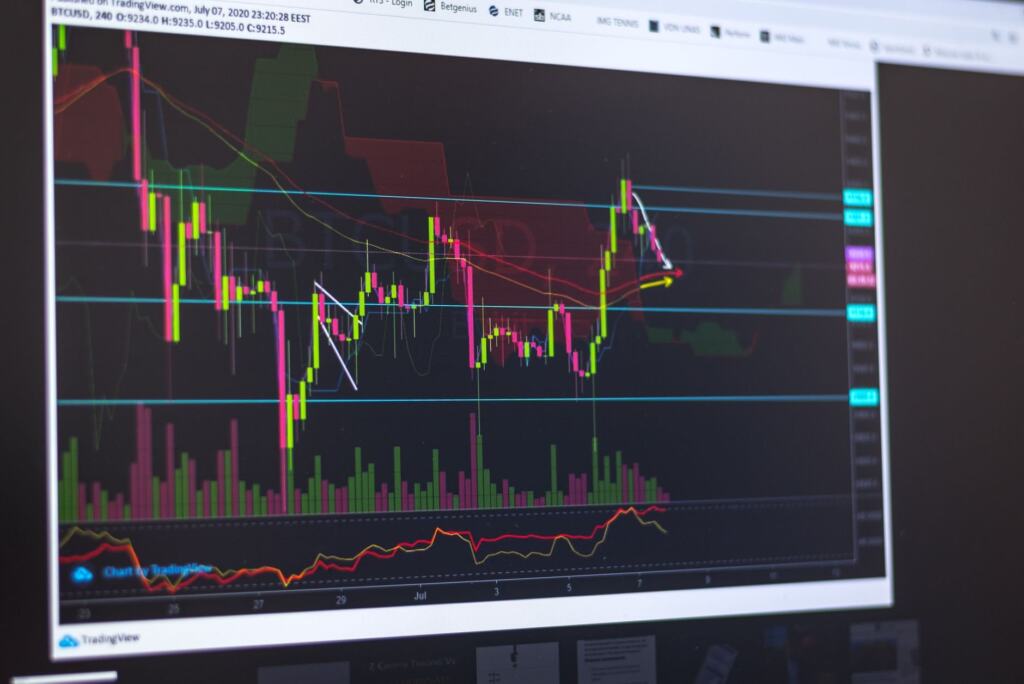
The order types OANDA lists for crypto are quick buy, buy limit, sell limit and sell stop. That set does not include OCO or trailing stops, so traders who depend on bracket-style exits should confirm what each platform’s order ticket offers before funding an account. Availability of stop-limit, OCO and trailing-stop orders differs by platform and is worth checking on the ticket itself.
API access for automated trading
API trading suits anyone running scripts, bots or systematic entries, and it separates platforms on documentation quality and limits. Blockchain Council lists API access and institutional tools among Kraken’s features, and OANDA describes tools and APIs through its Paxos partnership on its cryptocurrency page.
Rate limits and supported order types sit in each exchange’s API documentation and can change, so read the current documentation before building a strategy around them. Start with small order sizes to see how the platform behaves under your request volume.
Bid-ask spread and liquidity
The bid-ask spread is the gap between the best price a buyer will pay and the best price a seller will accept, and every market order crosses it. Robinhood’s average of about 0.55% per trade shows how a spread-based model can cost more than an explicit fee, as noted by Blockchain Council. OANDA, by contrast, states that it applies no spread markup and charges its fee openly.
OANDA’s Bitcoin specification on its cryptocurrency page lists a minimum order size of 0.0001, a maximum of 10 and a tick size of 0.25. Typical live spreads on major pairs change with market conditions, so compare the order book of your chosen pair during your normal trading hours.
Tax and regulatory points for day traders
Day trading profits are taxable. If investments are held for a year or less, ordinary income taxes apply to any gains, per TurboTax. That puts almost every day trade in the higher-taxed category.
The Journal of Accountancy describes a trader in securities as someone who seeks to profit from daily market movements rather than from dividends, with substantial and regular activity. Those who qualify can make a Sec. 475(f) election, due by the original due date of the prior year’s return. This guidance is written for securities, so confirm how it applies to crypto with a tax professional.
Decision checklist
- Decide whether you trade mainly with limit orders or market orders, since that determines whether maker or taker fees dominate your costs.
- Check whether a subscription tier, such as Kraken Plus or Coinbase One, matches your typical order size and frequency.
- Confirm the order types you need, such as stop-limit, OCO or trailing stop, on the live order ticket.
- Read the API documentation for rate limits if you plan to automate anything.
- Compare live spreads on your pairs, not only headline fees.
- Set up transaction export for tax records before trading volume builds.
Frequently asked questions
Do exchanges charge anything besides trading fees?
Yes. The Journal of Accountancy lists commissions, platform fees, data fees and interest on margin-based loans as typical day trading costs. TurboTax adds that while brokerage fees are mostly disappearing, some firms still charge fees on certain transactions.
Can day trading losses reduce my tax bill?
Up to $3,000 in excess losses per year can offset ordinary income, per TurboTax. If a Sec. 475(f) election is made, the Journal of Accountancy says the $3,000 capital loss limitation does not apply to trading losses.
Can I use leverage or short sell spot crypto?
Not on OANDA: its crypto page says leverage is not available for spot cryptocurrencies, and short selling is not allowed. Securities day traders using margin can sometimes reach three to four times their own equity capital, according to the Journal of Accountancy, and then pay interest on those loans.
Can I trade crypto at weekends?
On OANDA, yes. Its cryptocurrency page notes that, unlike traditional markets, you can trade during normal trading hours and over the weekend.